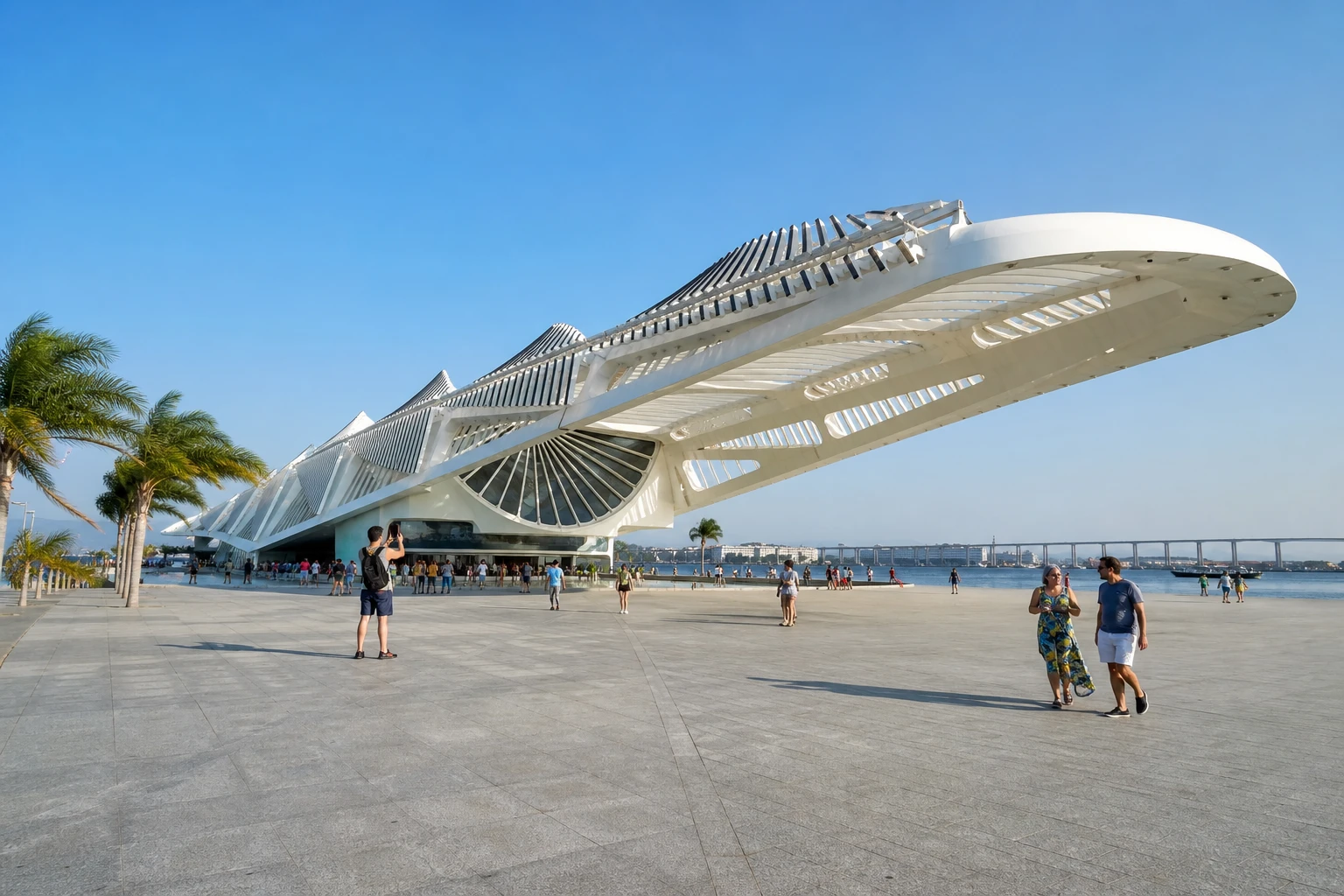
The Museum of Tomorrow, known locally as Museu do Amanhã, stands at Praça Mauá, 1, in downtown Rio de Janeiro’s port zone. It is a practical anchor for a culture-focused day in Centro and is included in Riotur’s museums and cultural centers directory. Its timed admission, direct VLT connection, and accessible facilities make advance planning straightforward, but arriving by car requires a little more thought.
- The published schedule is Thursday through Tuesday, 10:00 to 18:00, with last entry at 17:00; the museum is closed on Wednesdays.
- Tickets are tied to a reserved day and time window, so arrive within the period shown on your booking.
- Listed admission is R$40 full price and R$20 half price, with documentation required for discounted or free categories.
- VLT Line 1 to Parada dos Museus is the simplest public-transit route recommended by the museum.
- There is no on-site parking; the nearest listed garage is in the RB1 building, about 100 meters away.
- Accessibility features include ramps, elevators, tactile elements, adapted bathrooms, Libras access, and a limited number of wheelchairs.
The museum is especially convenient for travelers building a day around downtown and the port area. Public transportation reaches the attraction directly, while drivers must use an external garage. Reserve your admission before organizing the rest of the day, because the selected entry window determines when you need to be at Praça Mauá.

Museum of Tomorrow, AquaRio & Olympic Boulevard in Rio de Janeiro
Get picked up at your hotel and drive up to Boulevard Olímpico or Porto Maravilha, the city's port area completely revitalized and with the newest to...

Rio's Downtown Walking Tour: Unveiling Rich History and Landmarks
Discover Rio's captivating history on our unforgettable Historical Walking Tour. Start at the renowned Museum of Tom...

Shore Excursion from Rio de Janeiro Port: Full Day City Tour
Discover Rio's city center and top attratcions such as Museu do Amanha with a private car tour from its port! Marvel...

The African Heritage in Rio and Olympic Boulevard Walking Tour
Discover the heart of Rio de Janeiro through its African roots on this walking tour. We start at Praça Mauá, home...
Plan your Museum of Tomorrow visit at a glance
| Planning detail | What to know |
|---|---|
| Location | Praça Mauá, 1, Centro, in Rio de Janeiro’s port zone |
| Published days | Thursday through Tuesday; closed Wednesday |
| Published hours | 10:00 to 18:00, with last entry at 17:00 |
| Ticket format | Valid for the reserved day and time window |
| Listed admission | R$40 full price and R$20 half price |
| Recommended transit | VLT Line 1 to Parada dos Museus |
| Parking | No on-site parking; RB1 garage is about 100 meters away |
| Accessibility | Ramps, elevators, tactile features, adapted facilities, Libras access, and limited wheelchairs |
Opening schedules, ticket prices, promotions, and transit arrangements can change. Review the current booking details before traveling, particularly if your plan depends on a discount, a specific entry time, or a VLT connection. This quick check is more useful than leaving extra time to solve a ticket problem at the entrance.
Is the Museum of Tomorrow worth visiting?
The museum is a strong choice for travelers who want to add a major cultural stop to a downtown Rio itinerary. Riotur includes it in the city’s directory of museums and cultural centers, while its Praça Mauá location places the visit in the port zone rather than the beach districts that dominate many first-time itineraries.
It also suits visitors who prefer public transportation. The recommended VLT stop serves the museum directly, and the official directions provide connections from both Central do Brasil and Uruguaiana. Travelers committed to driving should weigh the lack of dedicated parking against the convenience of the nearby external garage.
The main planning limitation is the timed ticket. A reserved window creates structure, but it leaves less room for a spontaneous arrival after another attraction runs late. Give the museum a firm position in your day rather than treating it as an optional stop to squeeze in whenever you reach Centro.
If this is your first trip, the broader Best Things to Do in Rio de Janeiro for First-Time Visitors guide can help you decide how a port-zone museum day fits alongside Rio’s beaches, viewpoints, and other headline attractions.
Museum tickets, prices, and discounts
Listed admission costs R$40 at full price and R$20 at half price. The museum requires supporting documentation for visitors using half-price or free admission categories. Check the category rules before booking, and bring the relevant document on the day rather than relying on a verbal explanation at entry.

The museum also lists a promotional R$10 ticket on the 10th day of each month. Because ticket promotions and admission prices are changeable, confirm that the offer applies to your intended date before planning around it.
Priority access permits one companion. This can matter for families or travel partners arranging a visit around an eligible guest, but it should not be confused with an additional free or discounted ticket. Select the correct admission categories for everyone in the group and review the terms shown during booking.
A simple ticket checklist
- Choose a date between Thursday and Tuesday, avoiding Wednesday.
- Select an entry window that works with your transportation plan.
- Check whether anyone in the group qualifies for half-price or free admission.
- Prepare the supporting documents required for discounted categories.
- Keep the booking confirmation accessible on arrival.
- Recheck the schedule and ticket conditions shortly before the visit.
A ticket is valid only for its reserved day and time window. Do not assume that an unused morning booking can automatically be presented later in the afternoon. If the day includes another timed attraction, allow breathing room between reservations so one delay does not disrupt both plans.

Best of Rio: Culture, Local Flavors, History & Beaches
Discover the vibrant essence of Rio de Janeiro in a compact tour that showcases the city’s most iconic spots. Stro...

10-hour Private Tour Rio In One Day: Christ, Sugarloaf, Selarón, Downtown
Discover Rio's most important touristic attractions on a private tour in the company of an expert guide. Visit Corc...

Pedicab Tour of the Historical City Centre in Rio De Janeiro
You'll experience Rio's historic centre and revitalised old port district by electric pedicab, a fun, safe and susta...
Opening days and the best time to schedule your entry
The published schedule runs Thursday through Tuesday from 10:00 to 18:00, with final entry at 17:00. The museum closes on Wednesdays. The last-entry cutoff is especially important because arriving near closing does not extend the operating day.
Choose an earlier window if the museum is the main purpose of your trip to Centro. That leaves more flexibility for transportation and for continuing elsewhere afterward. A later reservation can work when you already plan to be downtown, but build the route backward from your ticket time rather than guessing when you will arrive.
Wednesday closure is the easiest detail to overlook when sketching a multi-day itinerary. Place the museum on another day before assigning flexible activities around it. If your trip is short, check the operating calendar before finalizing a larger Centro plan.
How to reach the Museum of Tomorrow by public transportation
The museum recommends taking VLT Line 1 to Parada dos Museus. This is the clearest public-transit option for visitors who want a named stop associated with the museum area. Use your reserved entry time to determine which service you need, and leave a reasonable buffer for waiting and transferring.
Travelers coming through Central do Brasil can use VLT Line 3 and transfer to the museum route. The official directions also describe metro and walking approaches from Uruguaiana. The best connection depends on where the day begins, so compare the route with your accommodation or previous stop before setting out.
Transit is generally the better match for this attraction than bringing a car. The museum has no dedicated parking, while its visitor guidance provides multiple VLT and metro approaches. This tradeoff is particularly relevant for a group deciding between a direct ride and navigating downtown with a private vehicle.
Planning the final approach
- Save the attraction name and Praça Mauá address before leaving.
- Use Parada dos Museus when planning a VLT Line 1 journey.
- Account for a transfer when traveling from Central do Brasil on VLT Line 3.
- Check the metro and walking approach if traveling through Uruguaiana.
- Aim to reach the area before the beginning of your ticket window, not at its final minute.
For general guidance beyond the museum route, Rio Safety Tips: Practical, Current Advice Without the Scare Stories offers a wider framework for moving around the city and planning daily transportation with confidence.
Driving and parking near Praça Mauá
There is no parking inside the museum complex. The nearest garage identified by the museum is in the RB1 building, approximately 100 meters away. Parking charges and space availability are not part of the museum admission, so drivers should treat parking as a separate step in the day.
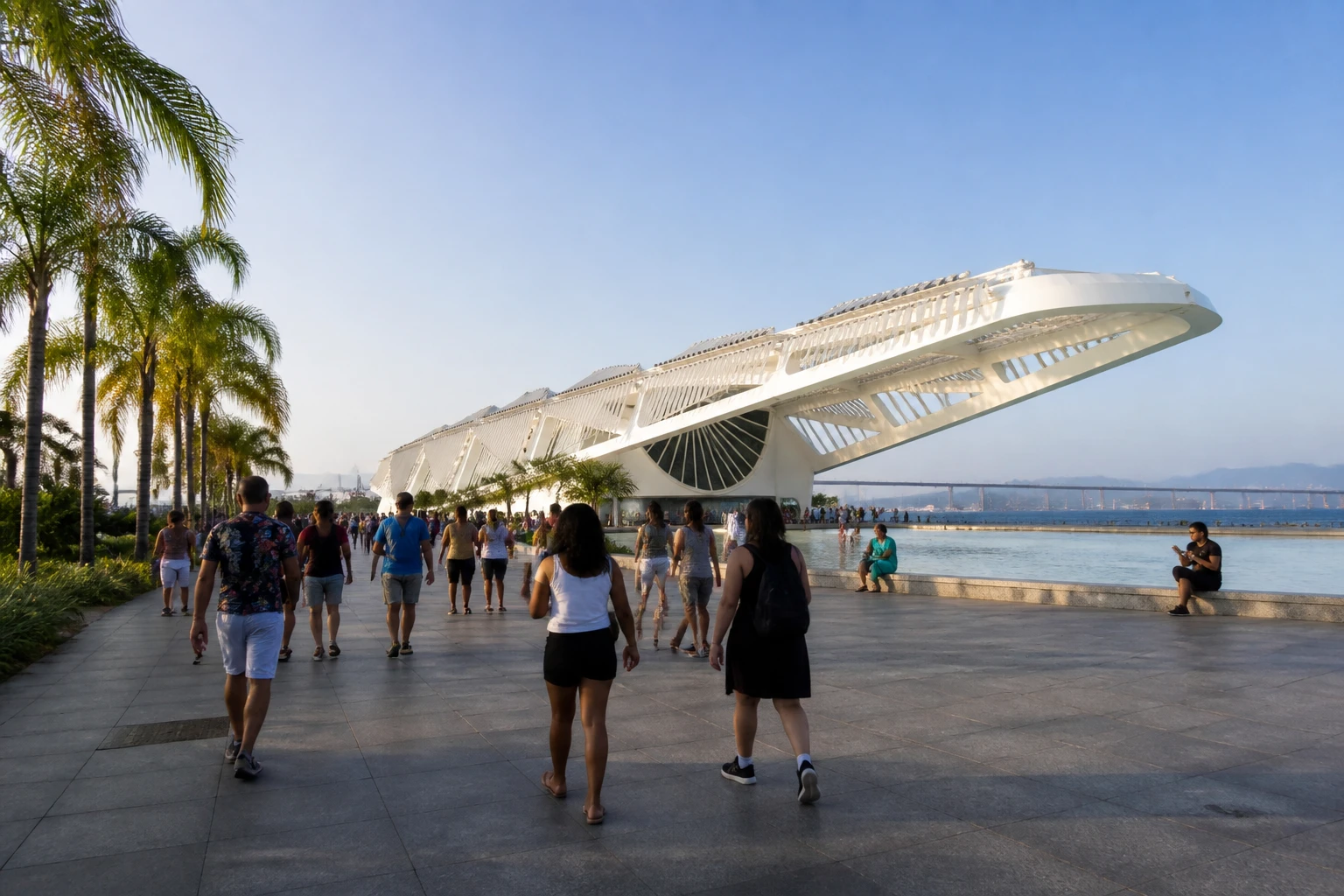
Driving works best when a private vehicle is necessary for the wider itinerary. Otherwise, the external garage adds an extra task to a visit already governed by a timed entry. If you do drive, navigate to the garage separately and leave enough time to park, gather your group, and cover the short distance to the museum.
Do not aim for the museum address with the expectation of finding a dedicated visitor lot on arrival. Setting the garage as the destination before departure creates a cleaner plan and reduces the risk of losing part of the admission window while circling the port area.
Accessibility features and advance planning
The museum lists a substantial range of accessibility features. These include tactile floors and models, ramps, elevators, adapted bathrooms, changing rooms, universal signage, Libras accessibility, and adapted educational programming. Together, these features address mobility, sensory, communication, and personal-care needs across several parts of the visitor experience.
A limited number of wheelchairs are available. Because the supply is explicitly limited, visitors who depend on a particular mobility arrangement should plan accordingly rather than assuming that equipment will always be waiting at the entrance.
Ramps and elevators support step-free movement, while tactile elements and universal signage provide additional orientation. Libras access and adapted educational programming can also be relevant when deciding which activities suit a group’s communication needs.
Priority access can include one companion. When booking, match each visitor with the appropriate ticket category and carry any documents needed to establish eligibility. Keeping the group’s tickets and supporting documents together can make arrival simpler.

12 Beaches Easy Bike Tour Rio de Janeiro
This cycling route along Guanabara Bay is a journey through Rio’s history and scenery. The ride begins in the revi...

Rio's city walking tour: a glimpse of history and olympic legacy
Take an afternoon sightseeing tour of Old Rio on foot, and get a feeling for the legends and history woven around th...

Best of Rio in One Day: Christ Redeemer, Sugarloaf & Local Lunch
Discover the best of Rio de Janeiro in just one day with a complete, well-organized itinerary designed to provide co...
How to structure the visit without rushing
Start by treating the reserved entry as the fixed point of the day. Add transportation time before it, then place flexible activities afterward. This order works better than filling the morning with several stops and hoping each one finishes exactly on schedule.
There is no need to pack every open hour into a single route. A focused museum visit followed by an adaptable Centro segment gives you room to respond to your own pace. Travelers who enjoy spending longer with displays should avoid placing another strict reservation immediately afterward.
For another culture-focused segment, a Selarón Steps and Centro walk can help shape a separate part of your downtown sightseeing plan. Keep any second activity flexible until you know how much energy and attention you want to give the museum.
A practical order for the day
- Confirm that the museum is open on your selected date.
- Book the admission category and entry window that fit your group.
- Choose the VLT, metro connection, or external parking plan.
- Arrive during the time shown on the ticket.
- Explore at a pace that suits your interests and accessibility needs.
- Continue with a flexible downtown activity rather than another tightly timed booking.
Visitor rules that matter on the day
Arrive within your reserved ticket window and keep your phone silent in exhibition spaces. Smoking is not permitted. These are simple rules, but remembering them before entry helps preserve a comfortable environment and prevents avoidable interruptions.

The museum can deny access when a visitor’s behavior threatens safety or preservation. Families and groups should stay aware of one another and follow staff instructions. The standard is practical: use the spaces respectfully and avoid conduct that could affect people, facilities, or exhibits.
A compact arrival routine is enough. Have the ticket and any eligibility documents ready, silence your phone, and make sure everyone understands the reserved entry requirement. This is more effective than sorting confirmations and discount documents while the group is already at the entrance.
What to bring to the Museum of Tomorrow
- Your ticket confirmation and reserved entry details
- Identification or supporting documents required for discounted or free admission
- A saved copy of the Praça Mauá address and transit route
- Any personal mobility or communication equipment you regularly depend on
- A flexible plan for the part of the day after the museum
Avoid relying on the museum’s limited wheelchairs if bringing your own mobility equipment is practical and necessary. Likewise, keep discount documentation with the person using the eligible ticket. Small organizational choices reduce stress at a timed attraction.
Who will get the most from this visit?
The Museum of Tomorrow is best suited to travelers who want a substantial cultural stop in downtown Rio and are comfortable organizing the day around timed admission. It is also a practical option for visitors using the VLT or combining several Centro and port-zone activities.
Visitors with mobility or communication needs have several documented facilities to consider, including ramps, elevators, tactile features, adapted bathrooms, Libras access, and adapted programming. The limited wheelchair supply is the main accessibility detail that benefits from advance thought.
The museum is less convenient for someone seeking an entirely spontaneous stop or expecting dedicated parking at the entrance. The fixed ticket window and off-site garage do not make the visit difficult, but they reward a clear plan.
Final planning advice
Book the Museum of Tomorrow when you want a major cultural attraction to anchor a downtown Rio day. Choose the ticket window first, then build transportation and other sightseeing around it. VLT Line 1 to Parada dos Museus is the simplest published transit approach, while drivers should navigate to the nearby RB1 garage rather than the museum itself.
The visit requires only a few firm decisions: avoid Wednesday, select the correct admission category, carry any required documentation, and arrive within the reserved window. Once those pieces are set, the museum becomes an easy centerpiece for exploring Rio beyond the beachfront districts.
Frequently asked questions
Where is the Museum of Tomorrow in Rio de Janeiro?
The museum is at Praça Mauá, 1, in Centro, within Rio de Janeiro’s port zone. The location is also associated with Píer Mauá.
What days is the Museum of Tomorrow open?
The published schedule is Thursday through Tuesday, from 10:00 to 18:00, with last entry at 17:00. The museum is closed on Wednesdays, and schedules should be checked again before visiting.
How much are Museum of Tomorrow tickets?
Listed admission is R$40 for a full-price ticket and R$20 for a half-price ticket. Documentation is required for free and discounted categories, and a promotional R$10 ticket is listed for the 10th of each month.
Do I need to reserve a time to visit?
Yes. Tickets are valid only for the reserved day and time window, so choose a slot that works with your transportation and arrive during the period shown on the booking.
What is the easiest way to reach the Museum of Tomorrow?
The museum recommends VLT Line 1 to Parada dos Museus. Directions are also available from Central do Brasil using VLT Line 3 and a transfer, and from Uruguaiana using metro and walking connections.
Does the Museum of Tomorrow have parking?
No, the museum does not have on-site parking. The nearest listed garage is in the RB1 building, about 100 meters away.
Is the Museum of Tomorrow accessible for wheelchair users?
The museum lists ramps, elevators, adapted bathrooms, changing rooms, tactile features, and a limited number of wheelchairs. Visitors who depend on loan equipment should keep the limited supply in mind when planning.
Can a companion use priority access with an eligible visitor?
Yes. Priority access allows one companion, although each member of the group still needs the appropriate admission arrangement.
What visitor rules should I know?
Arrive within your ticket window, keep phones silent in exhibition areas, and do not smoke. Access can be denied when behavior threatens safety or preservation.
Museum of Tomorrow, AquaRio & Olympic Boulevard in Rio de Janeiro
Get picked up at your hotel and drive up to Boulevard Olímpico or Porto Maravilha, the city's port area completely revitalized and with the newest to...
The African Heritage in Rio and Olympic Boulevard Walking Tour
Discover the heart of Rio de Janeiro through its African roots on this walking tour. We start at Praça Mauá, home...
Rio's Downtown Walking Tour: Unveiling Rich History and Landmarks
Discover Rio's captivating history on our unforgettable Historical Walking Tour. Start at the renowned Museum of Tom...
Shore Excursion from Rio de Janeiro Port: Full Day City Tour
Discover Rio's city center and top attratcions such as Museu do Amanha with a private car tour from its port! Marvel...
Still comparing Museum Of Tomorrow Rio De Janeiro?
Ask for tour ideas, hotel suggestions, or a simple trip plan that combines both.