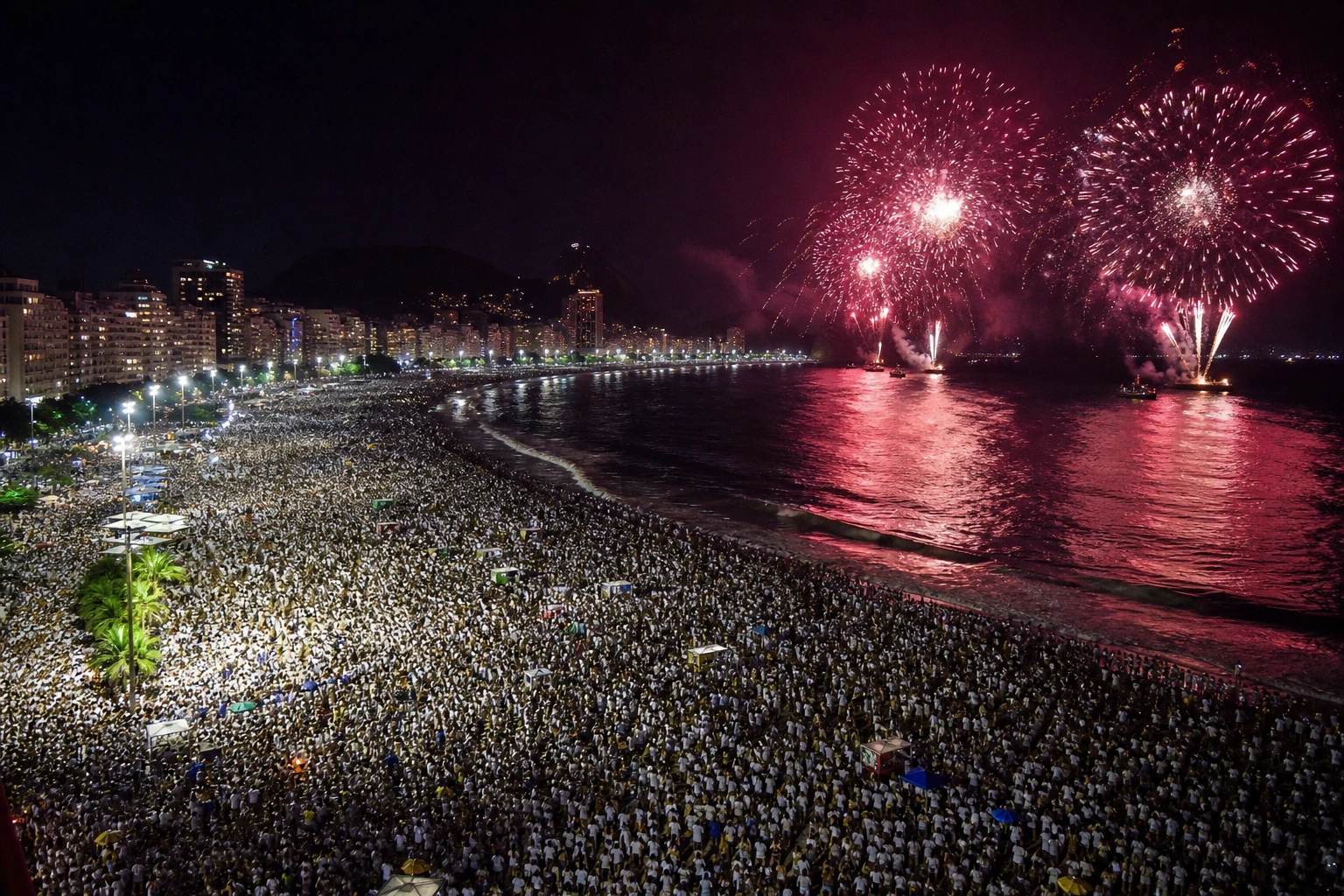
New Year's Eve in Rio de Janeiro requires more planning than an ordinary night out. Copacabana is the main draw, but its enormous crowd makes transport, accommodation, meeting points, and the trip home just as important as the midnight celebration. The event welcoming 2026 drew more than 2.6 million people to Copacabana, within a citywide total of about 5.1 million.
- Choose your accommodation and walking route before making evening plans.
- Treat MetroRio's New Year's operation as a special system with event-specific access rules.
- Expect road closures around Copacabana and avoid relying on door-to-door transport.
- Carry a small bag and check the current restrictions before leaving your accommodation.
- Set a clear meeting point because dense crowds can slow movement and separate groups.
Detailed rules for the celebration welcoming 2027 had not been released by late July 2026. The previous operation is useful for shaping a plan, but its fare, access method, station rules, operating times, and road closures should not be treated as confirmed for the next event. Recheck the current MetroRio and city guidance close to December 31.

Full Day in Rio: Christ, Sugarloaf, Selarón & Barbecue Lunch
Experience a full-day tour of Rio de Janeiro, visiting all the city’s must-see attractions in a single day! See the iconic Christ the Redeemer Stat...

The Best Half Day in Rio with Christ Redeemer and Sugar Loaf Hill
Enjoy a small-group tour to visit the most iconics landmarks in Rio de Janeiro. First visit the Christ the Redeemer...

Rio's Full Day: Selarón Steps, Christ & Sugarloaf – Tickets & Lunch Included
Discover the best of Rio de Janeiro in a full-day tour that combines convenience, comfort, and expert guidance. This...

Rio: Copacabana Food Tour with 7 Tastings and Local Flavors
Discover the vibrant flavors of Rio de Janeiro with Secret Food Tours! Your local expert guides will take you throug...
Decide whether Copacabana fits your celebration style
Choose Copacabana if being near Rio's principal official fireworks area matters more than personal space or a fast departure. Millions gathered there for the celebration welcoming 2026, so crowding is a defining part of the experience rather than a minor inconvenience. The scale can feel thrilling at midnight, yet it also makes walking, regrouping, and leaving slower.
Your most useful decision is not where to stand down to the last meter. It is how much crowd exposure your group can manage. Travelers who dislike dense gatherings, need predictable mobility, or have young children should consider an evening closer to their accommodation. Those heading to Copacabana should agree in advance on when to arrive, how to return, and what to do if separated.
The return journey is the main tradeoff. A crowd of more than 2.6 million cannot disperse immediately after the celebration, and special transport rules limit how freely travelers can change plans. Leave with patience, keep your group together, and avoid scheduling anything time-sensitive soon after midnight.
Choose accommodation around your walking and Metro route
Staying within a manageable walk of your preferred viewing area removes much of the uncertainty surrounding the return trip. It can also place you inside the busiest part of the event zone, so balance convenience against noise, crowds, and restricted vehicle access. A practical guide to where to stay in Copacabana can help narrow the neighborhood options before booking.
If you stay outside Copacabana, work backward from the return journey. Identify the station or route permitted under the current New Year's plan, estimate the walk from the event area, and save the details on every group member's phone. Do not assume that the station used on arrival will also accept return passengers under the special operation.
Travelers comparing Ipanema or Copacabana as a base should give extra weight to New Year's logistics. A room that looks close on a map can still involve a long walk through controlled streets and packed public areas. Check the property's access instructions and decide whether everyone in the group can comfortably complete the route.
Book with enough flexibility to respond when the official plan is published. If selecting a hotel or rental specifically for New Year's Eve, review cancellation terms, guest access, check-in arrangements, and any building procedures that affect entry during street closures. Keep the address saved offline in case mobile service becomes difficult to use in the crowd.
Understand how the special MetroRio operation works
MetroRio does not necessarily operate like it does on a normal evening. For the celebration welcoming 2026, the special operation ran from 7 p.m. on December 31 until 5 a.m. on January 1. Outbound boarding used a QR code, while the return required a wristband and was limited to designated stations.

That year's special pass cost R$15. During the special window, ordinary single tickets, contactless bank-card payment, RioCard, Jaé, and RecargaPay QR codes were not accepted. These details show why a normal transit routine is not enough on New Year's Eve, but the next event can have different prices and procedures.
| Part of the plan | Operation welcoming 2026 | How to prepare for the next event |
|---|---|---|
| Special operating period | 7 p.m. on December 31 to 5 a.m. on January 1 | Confirm the new operating window before travel. |
| Outbound boarding | Special QR code | Save or collect the required credential in advance. |
| Return boarding | Wristband and designated stations | Know the permitted return station before entering the crowd. |
| Special fare | R$15 | Check the newly published price rather than budgeting around the old fare. |
| Other payment methods | Several normal methods were not accepted | Do not assume your everyday transit card or bank card will work. |
Once the new plan appears, read it as a complete set of instructions. Check the correct credential for each direction, where it is obtained, the permitted boarding period, and the return stations. Save screenshots rather than depending on a live webpage in a dense crowd. Every traveler should carry their own access credential unless the published instructions clearly say otherwise.

Rio Maracana Stadium Football Match Ticket & Private Transport
***JOGA BONITO*** Step into the heart of Brazil’s passion with a once-in-a-lifetime experience: attending a live...

Best of Rio in One Day: Christ Redeemer, Sugarloaf & Local Lunch
Discover the best of Rio de Janeiro in just one day with a complete, well-organized itinerary designed to provide co...

Christ the Redeemer & Sugarloaf: Rio City Tour with Lunch
Discover Rio de Janeiro’s top attractions on a guided small-group tour. Visit Christ the Redeemer and Sugarloaf Mo...
Plan for road closures and a longer walk
The municipal plan for the celebration welcoming 2026 closed Avenida Atlântica and other streets on the Copacabana side of the event. Vehicle access near the beachfront therefore cannot be treated as normal. Even if a taxi or ride service handles part of your journey, expect to finish on foot outside the restricted zone.
Do not make parking near the celebration the foundation of your plan. Street controls can change the usable approach, and the large crowd makes a quick vehicle departure unrealistic. If someone in the group cannot walk far, solve that issue before the evening by choosing suitable accommodation, an appropriate station, or a celebration closer to the lodging.
Save two routes: your preferred route and a simple fallback. Both should lead to a place everyone can identify without relying on temporary barriers, vehicles, or a packed station entrance. Allow extra time for slow pedestrian movement. The shortest line on a map is not always the easiest path when streets are controlled and thousands of people are moving together.
Build a flexible New Year's Eve timeline
A useful timeline begins with transport deadlines rather than midnight. Once the current operating plan is published, place its boarding windows, credential requirements, and road closures into your schedule. Then add meals, preparation time, the walk to the event zone, and a generous crowd buffer.
- Morning: confirm the weather, transport notices, group contacts, accommodation access, and the current prohibited-item list.
- Afternoon: eat, charge phones and power banks, distribute credentials, and place identification and essentials in small secure bags.
- Departure: leave according to the official transport window, not according to how long the trip takes on a normal day.
- Before joining the densest crowd: identify a fixed reunion point and make sure every person knows the return route.
- After midnight: pause if necessary, keep the group together, and expect the station approach and boarding process to take time.
Avoid an itinerary that depends on several precise connections. New Year's Eve is better handled as one main event with a clear outbound route and a clear return route. Adding distant dinner reservations, multiple parties, or a transfer immediately after midnight creates more opportunities for closures and crowds to disrupt the plan.
Pack lightly and follow event restrictions
MetroRio's previous special operation prohibited coolers, bags larger than 25 liters, glass bottles, fireworks, bicycles, boards, and similar bulky items. Check the new list before packing because rules can change. A compact bag is easier to manage in turnstiles, on crowded trains, and during the walk through Copacabana.

- Official identification and any documents needed for fare eligibility
- The required MetroRio access credential for each part of the journey
- A charged phone and compact power bank
- Essential medication and a small amount of personal supplies
- Water in a permitted non-glass container, if allowed by the current rules
- The accommodation address and group meeting point saved offline
Leave nonessential valuables at your accommodation. Keep what you carry in a closed bag positioned where you can monitor it, especially during station queues and dense pedestrian movement. Avoid bringing anything that would be difficult to carry for several hours or that could be refused under the special transport rules.
Still comparing Rio De Janeiro New Year's Eve Planning?
Ask for tour ideas, hotel suggestions, or a simple trip plan that combines both.
Trip Helper
Use the accessibility guidance to choose a route
For the operation welcoming 2026, MetroRio stated that all stations were accessible. Because of station depth and heavy demand, it specifically recommended Siqueira Campos/Copacabana for passengers with disabilities or reduced mobility. Treat that as a previous recommendation and check which station the current event plan identifies.
The city plan required official documents at the turnstiles for people with disabilities, children covered by the age exemption, and adults over 65. Previous notices described the child threshold differently, so families should follow the exact eligibility wording in the current MetroRio event instructions. Carry the applicable official identification rather than relying on a photo or explanation at the gate.
Accessibility planning should cover the entire route, not just the train. Consider the walk between the station, viewing area, and accommodation, plus long periods of standing and slow movement after midnight. Choose a fixed meeting location and make sure companions understand the route before entering the busiest area.
Keep families and groups together
Large groups should divide responsibility rather than letting one person hold every credential and address. Each capable traveler should know the accommodation name, return station, meeting point, and contact numbers. Parents can place identification and accommodation details securely with children while keeping their own copies.
Choose a reunion point before approaching the densest part of the celebration. It should be a fixed place away from the immediate flow toward station entrances. Temporary barriers, parked vehicles, and vendor setups are poor landmarks because they can move or disappear.
Families should judge the evening according to their least mobile or least crowd-tolerant member. A shorter stay near the edge of the gathering can be more manageable than pressing toward the busiest area. If the return journey becomes tiring, the original accommodation choice will matter more than an ambitious viewing position.
Apply simple safety habits in the crowd
New Year's Eve safety starts with reducing avoidable complications. Carry fewer valuables, keep phones out only when needed, close bags after every use, and avoid placing wallets in easy-to-reach pockets. Practical Rio safety tips are especially useful for preparing a low-profile way to carry essentials before joining the celebration.

Keep enough battery for the journey home. Save the address, route, access credentials, and meeting point offline, then share the same information with the group. If separated, follow the agreed plan rather than moving unpredictably through the crowd while everyone searches in different directions.
Pay attention to official barriers, transit staff, and changing pedestrian flows. Do not carry fireworks or glass, and do not bring a large bag that could be refused during the special Metro operation. The simplest setup is usually the safest and the easiest to manage.
Budget for transport, accommodation, and flexibility
Do not use the previous R$15 MetroRio pass as the confirmed price for the next celebration. Add a separate New Year's transport line to your budget and update it when the new fare is released. Include accommodation, meals, and any private reservation, plus enough flexibility for a changed route or later return.
Accommodation is the purchase most likely to shape the entire night. Compare the total walking distance, cancellation conditions, guest-access rules, and location relative to your intended route. A lower room price farther away can lose its advantage if the group is uncomfortable with the late return.
If booking a private dinner or party, check what admission includes and how guests enter during road controls. Confirm the cancellation policy and the realistic route back to your accommodation. Avoid combining nonrefundable plans in different parts of the city unless the current transport plan clearly makes the sequence practical.

4x4 Tijuca National Park Rio de janeiro
Hike through the Tijuca National Park on this 4-hour tour. Stop at a refreshing natural lagoon for a brief swim befo...

Half-Day Tour: Christ the Redeemer, Selarón & Sunset at Sugarloaf
Spend an amazing afternoon visiting the best of Rio: Christ The Redeemer Statue atop Corcovado Mountain, Sugarloaf C...

Full Day in Rio: Christ by Train, Sugarloaf, Selarón & Barbecue
Discover the best of Rio de Janeiro in a single day! Begin with a scenic train ride up Corcovado Mountain to visit C...
Consider a celebration outside the densest Copacabana crowd
Rio's New Year's celebrations extend beyond a single gathering. About 5.1 million people participated citywide in the celebration welcoming 2026, while more than 2.6 million were in Copacabana. The figures underline both Copacabana's appeal and the value of considering a plan closer to your accommodation.
A lower-stress evening can center on a meal or gathering within walking distance of where you are staying. This option suits travelers who prioritize an easier return, personal space, or fewer transport dependencies. Review the current city program before choosing, since locations and event arrangements can change each year.
If your heart is set on Copacabana but the crowd is a concern, compromise on position rather than logistics. Choose a manageable route, stay near your group, and accept that the best place is the one everyone can reach and leave safely. A complicated midnight plan rarely improves with several million additional pedestrians.
Leave the next morning open
Keep January 1 flexible, especially if you expect a slow return through Copacabana or the Metro system. A late arrival at your accommodation can make an early tour or timed attraction unnecessarily difficult. Save structured sightseeing for later in the trip and use a guide to the best things to do in Rio de Janeiro when building the remaining days.
Before going to bed, place transit credentials, identification, and valuables back in a secure location. Check any notices that affect the following day before setting out again. The special overnight operation ends on its own schedule, so normal service should not be assumed until the current transport guidance says it has resumed.
Use this final planning checklist
- Recheck the official MetroRio and municipal New Year's plans close to December 31.
- Confirm the outbound credential, return credential, fare, station, and operating window.
- Save the walking route, accommodation address, and reunion point on every phone.
- Pack within the current bag, glass, fireworks, and bulky-item restrictions.
- Carry official identification required for any accessibility or age-based fare benefit.
- Leave enough time and flexibility for slow movement after midnight.
Rio de Janeiro's New Year's Eve celebration suits travelers who enjoy immense public gatherings and are willing to plan carefully around them. Copacabana delivers the grandest sense of scale, but its main limitation is the demanding return journey. Choose accommodation and transport first, keep the evening simple, and update every operational detail when the new official plan is released.
Frequently asked questions
How crowded is Copacabana on New Year's Eve?
Copacabana can receive crowds numbering in the millions. More than 2.6 million people gathered there for the celebration welcoming 2026, so expect dense pedestrian movement and a slow departure after midnight.
Does MetroRio operate normally on New Year's Eve?
No, MetroRio can use a special New Year's operation with dedicated credentials, hours, fares, and return stations. The operation welcoming 2026 used QR-code boarding outbound and wristbands for the return.
Can I use a contactless bank card or regular transit card during the special operation?
Do not assume normal payment methods will work. During the operation welcoming 2026, contactless payment, ordinary single tickets, RioCard, Jaé, and RecargaPay QR codes were not accepted in the special window, but the next event can use different rules.
Can I bring glass bottles or a large cooler on the Metro?
The previous special operation prohibited glass bottles, coolers, and bags larger than 25 liters. Check the current prohibited-item list before packing because restrictions can change.
Which Metro station is recommended for reduced mobility?
Siqueira Campos/Copacabana was MetroRio's recommendation for people with disabilities or reduced mobility during the operation welcoming 2026. Confirm the recommendation again when the next event plan is published.
Should I drive to Copacabana for New Year's Eve?
Driving should not be the foundation of a Copacabana plan. The previous municipal operation closed Avenida Atlântica and other nearby streets, making walking and special public-transport arrangements central to access.
Where should I stay for New Year's Eve in Rio?
Stay within a walking distance your group can manage or near a station permitted by the current special operation. Copacabana offers the simplest walk to the principal celebration, while staying farther away can reduce exposure to the densest crowd but adds transport planning.
How much did the special New Year's Metro pass cost?
The special pass for the operation welcoming 2026 cost R$15. That is a historical price rather than a confirmed fare for the next celebration, so check the newly published event guidance.
Rio's Full Day: Selarón Steps, Christ & Sugarloaf – Tickets & Lunch Included
Discover the best of Rio de Janeiro in a full-day tour that combines convenience, comfort, and expert guidance. This experience includes lunch, admiss...

Private Rio Tour: Christ the Redeemer & Sugar Loaf Essentials
Enjoy a personalized visit to Rio de Janeiro’s essentials with a private guide and driver. The tour covers key hig...
The Best Half Day in Rio with Christ Redeemer and Sugar Loaf Hill
Enjoy a small-group tour to visit the most iconics landmarks in Rio de Janeiro. First visit the Christ the Redeemer...
Rio: Copacabana Food Tour with 7 Tastings and Local Flavors
Discover the vibrant flavors of Rio de Janeiro with Secret Food Tours! Your local expert guides will take you throug...